
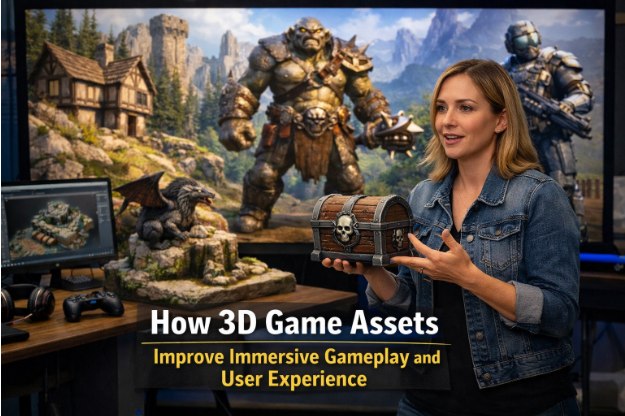
The characteristic of the modern game is the element of immersion. The players demand in-depth worlds, realistic characters, and interactive worlds, which become reactive and alive. What lies behind these experiences is the strategic use of 3D game assets, which are involved in every aspect, such as visual storytelling and gameplay. Game assets should not be just attractive when designed properly; they have a direct impact on how a person interacts, investigates, and relates to a game.
The advancement of game development of games on different platforms like PC, console, mobile, and virtual reality has meant that the quality of the assets created has to be high in order to provide users with the most engaging experiences.
Development of Believable Game Worlds
The first step is realism and consistency. Properly developed properties assist in building an atmosphere that is persuasive and unified. Terrain, structure, flora, props, and objects of interaction have to collaborate with each other to produce an authentic environment.
Quality assets will add value by:
- Creating aesthetic uniformity in settings.
- Strengthening of the narrative settings and themes.
- World-building with assistance by detail and scale.
- Bringing in-game spaces to life and interaction.
In cases of visual consistency of the environment, the likelihood of the players being engrossed in the experience is higher.
Improving Interaction and Engagement With the Players
These assets are not mere cosmetics, but they have a practical role in the game. Objects, weapons, tools, and interfaces give directions on how the players can interact with the game world.
Good interaction is enhanced through effective asset design:
- Distinct indicators of interaction elements.
- Discoverable patterns of quick gameplay choice.
- Working feedback and smooth animation.
- Inherent correspondence with gameplay.
Well-planned 3D game resources enable the player to know what to do without any confusion and improve the flow.
Justifying Emotional Connection and Storytelling
Details in visual form are important in emotional appeal. Mood, tension, and narrative are conveyed through the use of characters and environments that are designed in a detailed way.
Assets help to tell stories in that they:
- Reflection of character personalities and backgrounds.
- Substituting story themes with environment design.
- Improving cinematic scenes and cut scenes.
- Building emotional appeal using visual appeal.
Powerful visual narrative makes the players more connected and increases their long-term involvement.
Enhancement of Performance Without Immersion
The immersion is not only based on the visuals but also on the stability of the performance. Frame rates, lag, or visual glitches break the gaming experience.
Optimized assets assist in keeping performance intact by:
- Effective counts of polygons.
- Use of enhanced textures and materials.
- Use of level-of-detail models.
- Minimizing unwarranted rendering loads.
Balanced optimization makes sure that there is no visual depth loss in games.
Enhancing Accessibility and Clarity of Gameplay
Clarity is also important in the immersion of the game. The excessively complicated or inconsistent properties may distract or annoy the players.
Adequately planned assets enhance availability by:
- Presence of visual acuity under light conditions.
- Being able to distinguish significant things.
- Intuitive navigation should be supported in the environments.
- Improving the readability range of player skills.
Asset design is clear and gives players the opportunity to concentrate on playing and not interpreting graphics.
Enabling Scalability and Content Expansion
Most of the current games are based on continuous updates, downloadable content, and live-service products. Scalability of assets will be important for long-term success.
Scalable asset processes make it possible to:
- Simple reutilization of the modular parts.
- Regular growth of the environment.
- Faster content updates
- Effective management of resources.
To ensure consistency in the assets due to the changing content of the games, the game studios often engage an experienced 3D visualization company.
Improving the Immersiveness of Hi-tech Systems
Virtual reality, augmented reality, and cross-platform gaming are the technologies that require a higher quality of assets. Gamers demand more realism and interoperability.
High-quality assets support:
- VR presence with three-dimensional largeness and depth.
- AR communication with precise spatial correspondence.
- Stable cross-platform migration.
- Uniform perceptions in devices.
Such aspects largely influence satisfaction and retention of players.
Why Asset Quality Impacts Player Retention
Initial impressions are important, and the visual quality over time is what counts in the long term. Games that have been fine-tuned and carefully planned have a higher chance of being revisited by the players.
The good asset design has the outcome of:
- Longer play sessions
- Higher replay value
- Greater involvement of the community.
- Good reviews and recommendations.
The ability to create immersive visuals will be a competitive edge in saturated gaming markets.
Conclusion
The immersive gameplay and favourable user experiences cannot be attained without high-quality 3D game assets. Assets impact almost all areas of game design, such as world-building and storytelling, as well as performance optimization and scalability.
Through careful creation of assets and the use of an expert 3D visualization firm, game developers can create visually rich and engaging worlds that immerse players and add to the experience of playing games. With an ever-growing set of expectations of the players, the immersive design of assets is a pillar of successful game development.